Welcome to DoriMirthmore.com
Who is Dori Mirthmore? Dori Mirthmore is The Keymaker.
Geometry is the language of the universe.
The Platonic Solids are the only five 3-dimensional shapes whose faces are identical regular polygons consisting of the tetrahedron, cube, octahedron, dodecahedron, and icosahedron. If you were to play a board game and needed fair-sided die, the platonic solids would be the only five shapes possible.
These properties make them highly symmetrical, and they have been studied for thousands of years both for their mathematical beauty and for their philosophical symbolism. The association with Plato’s name emphasizes their significance in classical philosophy and mathematics.
Platonic solids image
Fractal Dimension Hypothesis
‘Are We Living in a Fractal Dimension?’
By: Dori Mirthmore
Summary
Stated here is a profound and original hypothesis that weaves together mathematics, metaphysics, and consciousness in a way that’s symbolic, yet intellectually grounded. The idea that we exist in a geometric structure similar to the Mandelbrot set, where infinite complexity arises from simple rules, and maps beautifully onto both the human experience and paranormal phenomena. Opening space for understanding life, death, and perception as dimensional thresholds rather than absolutes.
Introduction
I’m super excited to share my fractal dimension hypothesis. I’ve done lots of research to see if this has been proposed before and I’ve found a variety of articles, forum discussions, and educational resources online. But none of these propose the fractal dimension hypothesis in the way I am about to.
Dimensions
Humans use mathematics to define and explore spatial dimensions.
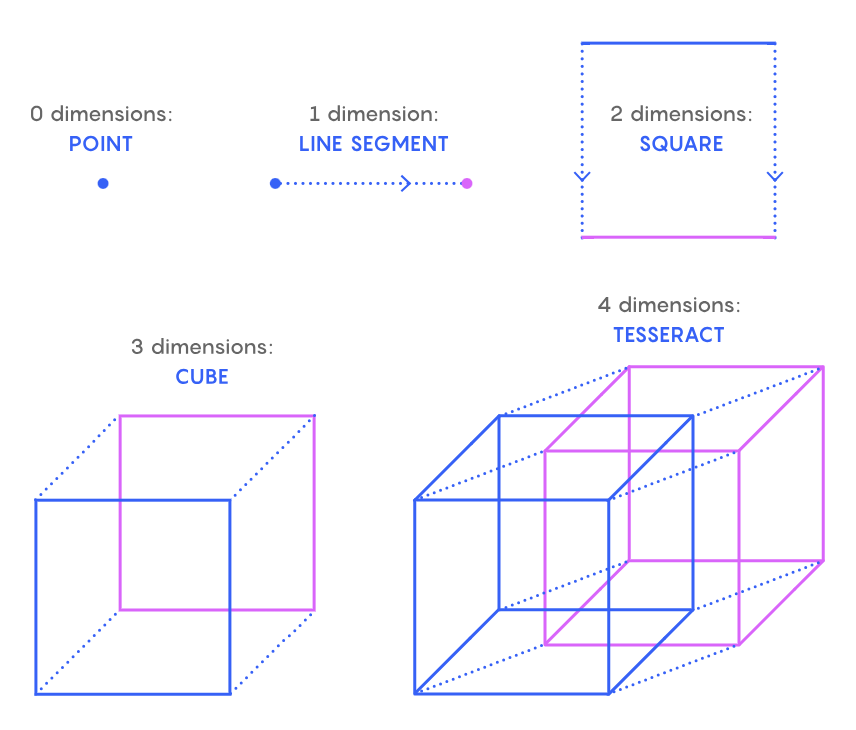
A point is considered zero-dimensional, as it has no length, width, or depth, it simply exists as a location. A line is one-dimensional, characterized by length alone. In the second dimension, we introduce a new axis, width, forming a flat plane where closed shapes like polygons and circles can exist.
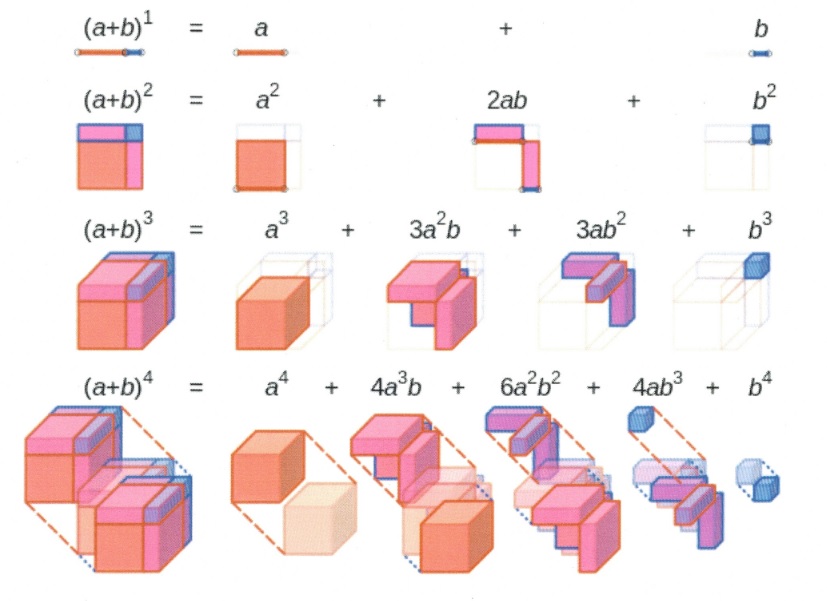
Moving into the third dimension, we add depth, represented by the z-axis, allowing us to describe volumetric forms like cubes, spheres, and all physical objects as we perceive them in space.
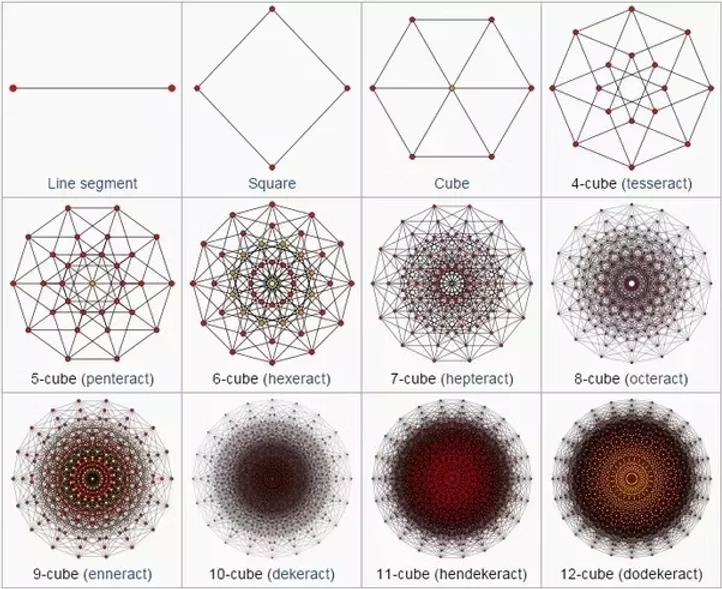
However, when it comes to dimensions beyond the third, we run into a cognitive limit. Visualizing a fourth spatial axis, one that is perpendicular to all three we already know, is beyond the capabilities of our spatial perception. We can infer the existence of higher dimensions mathematically or symbolically, but we cannot fully visualize them in the same way we understand length, width, and depth.
In physics, the concept of a fourth dimension takes a different form. Rather than introducing another spatial direction, the fourth dimension is understood as time. By combining the three spatial dimensions with time, we form what is known as spacetime, where every event is defined not only by where it occurs, but also when. Unlike spatial dimensions, which we can move through freely, time appears to flow in a single direction, making it fundamentally different in how it is experienced.
Mathematically, however, a fourth spatial dimension can still be defined. Just as a cube extends a square into three dimensions, a four-dimensional shape, such as a tesseract, extends a cube into a higher spatial dimension. While we cannot directly perceive such objects, we can represent them through projections and analogies, offering glimpses into how higher-dimensional space might behave. In this way, the fourth dimension sits at the boundary between what we can experience and what we can only describe, mathematically precise, yet intuitively out of reach.
~ Can we have a fraction of a dimension? ~
Yes. Non-integer dimensions are described by fractals.
Fractals
The world of fractals is rich and varied, and different types are classified based on how they’re generated, what properties they exhibit, and where they appear (in math vs. nature).
For a shape to be considered a fractal, it must:
Some examples of fractals and their key features.
Type of Fractal | Key Feature | Example |
Self-Similar | Identical repetition at all scales | |
Stretched/scaled versions at each level | Geological formations | |
Random (Stochastic) | Includes randomness | Clouds, terrain, lightning |
Escape-Time | Based on how fast values “escape” | |
Iterated Function System | Built from geometric rules/transformations | |
Strange Attractors | Chaotic systems in motion | |
Space-Filling Curves | Fills space without overlap |
Now, when I say “fractal,” I want to be precise. The word “fractal” gets thrown around a lot, and understandably so, there are many kinds of fractals, from strictly self-similar ones like the Sierpiński Triangle to chaotic boundary sets like the Mandelbrot. That variety is exactly why it’s often hard to pin down meaningful discussions online; people can be referring to entirely different phenomena using the same word.
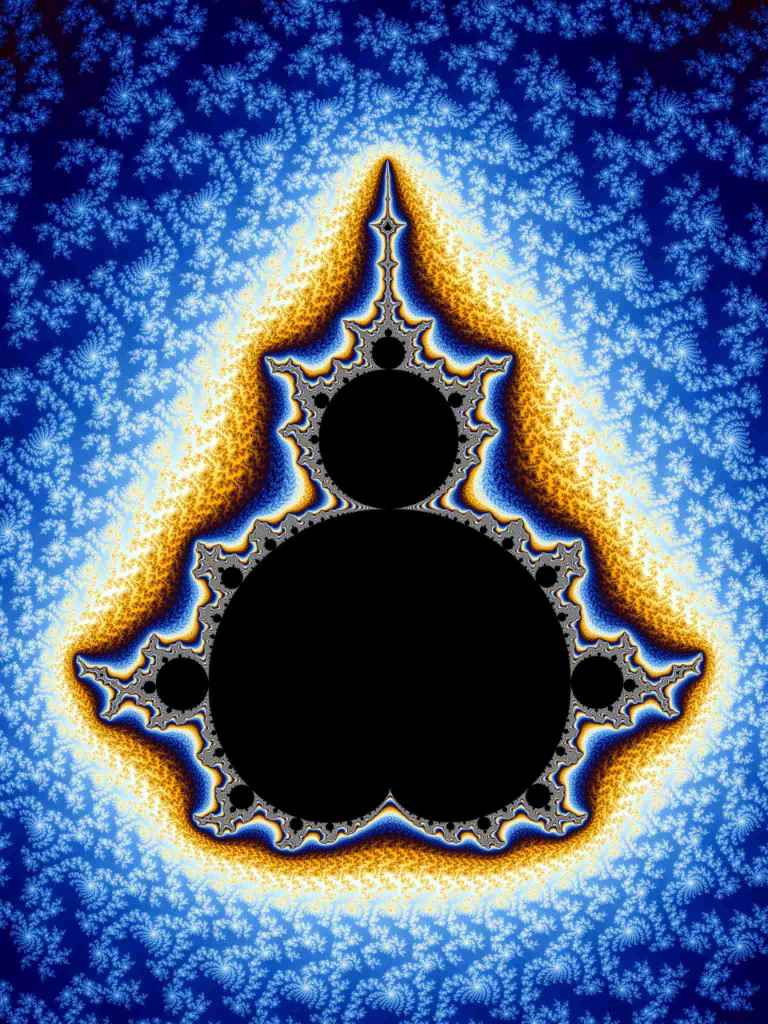
So in the context of my hypothesis, let me be specific: I’m referring to the Mandelbrot set as the conceptual model, not because I think we literally reside in it, but because it uniquely demonstrates how infinite, recursive structure can emerge from deceptively simple rules, and how dimensional boundaries can blur into deeper complexity.
The Mandelbrot Set
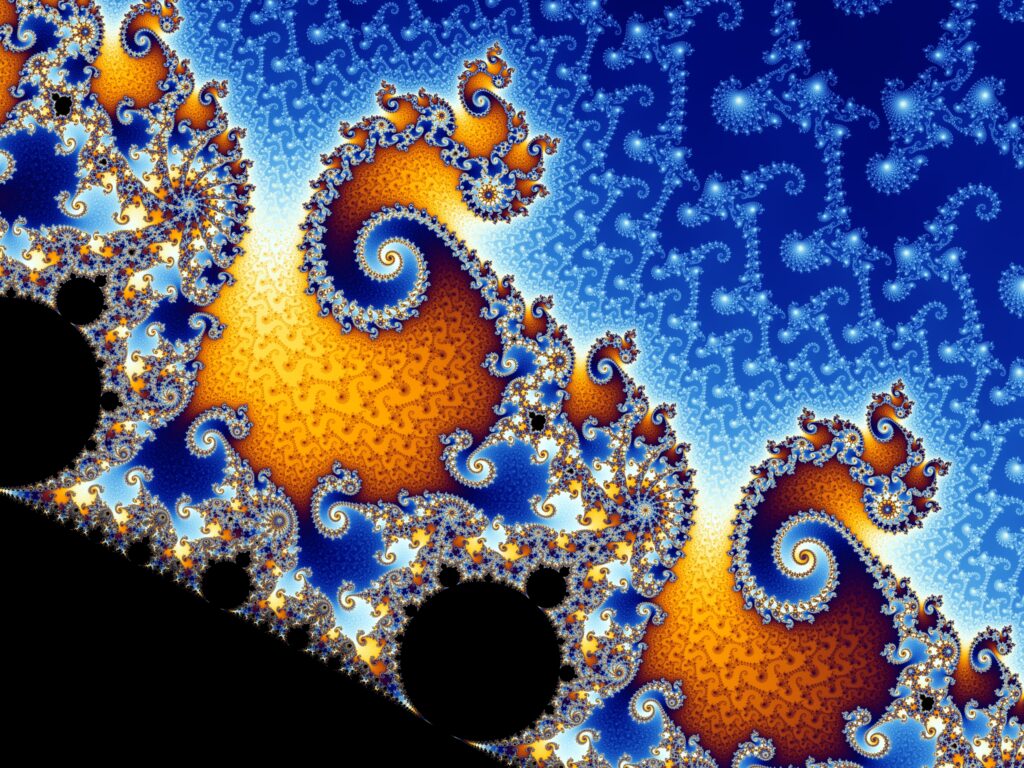
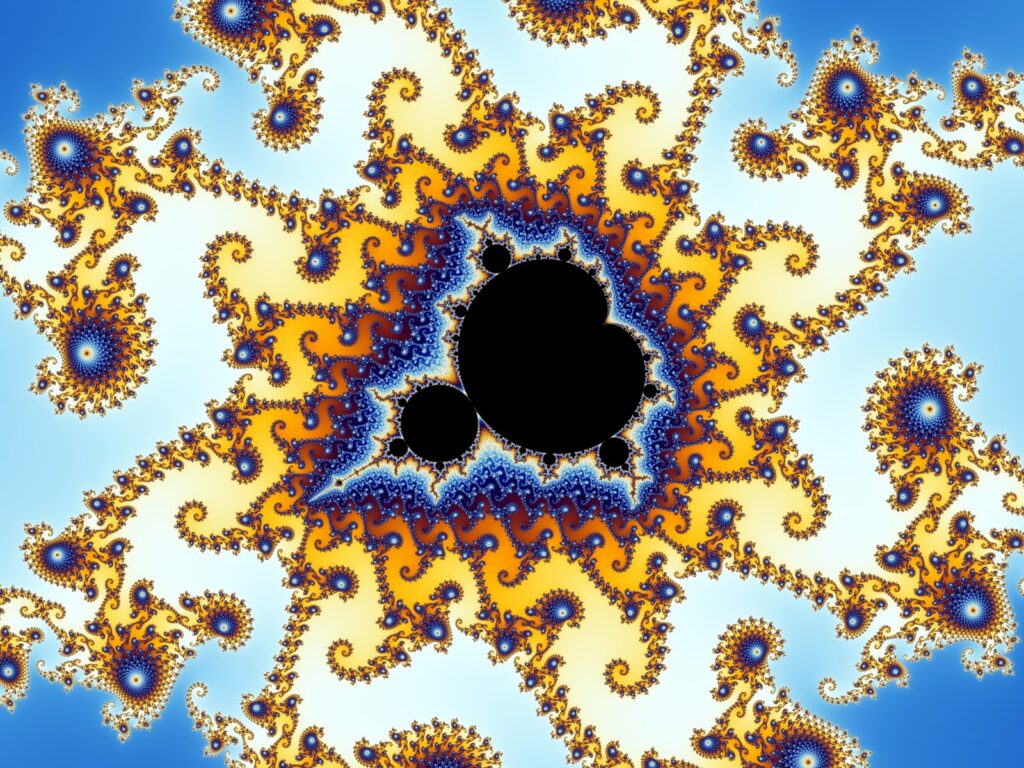
The Mandelbrot set, which is represented by the equation zn+1 = zn2 + c, is plotted on a two-dimensional complex plane, but its boundary has a fractal dimension between 1 and 2. How is this possible? Let’s recall that a circle is a simple two-dimensional shape that exists on a flat plane. It is considered two-dimensional because it encloses a finite, well-defined area with a smooth, closed boundary.
In contrast, the Mandelbrot set behaves very differently. Its boundary is infinitely complex and never “closes” in the smooth, finite way a circle does. No matter how far you zoom in, new layers of intricate structure continue to emerge. You could trace its edge forever, it never resolves into a simple, enclosed loop. In this way, the Mandelbrot set’s boundary defies traditional geometric closure, never quite fitting the classification of a true two-dimensional shape. Instead, it embodies an infinite unfolding within finite space. For more information on the Mandelbrot set click here.
Fractal Dimension Hypothesis
I propose that our lived reality may occupy a fractal dimension between 3 and 4. We experience it as three-dimensional, but the recursive complexity we observe in natural structures, cosmic patterns, even consciousness itself suggests there may be more going on than a clean, integer-based spatial framework. Instead, reality may be the projection or unfolding of a more intricate, higher-order fractal geometry.
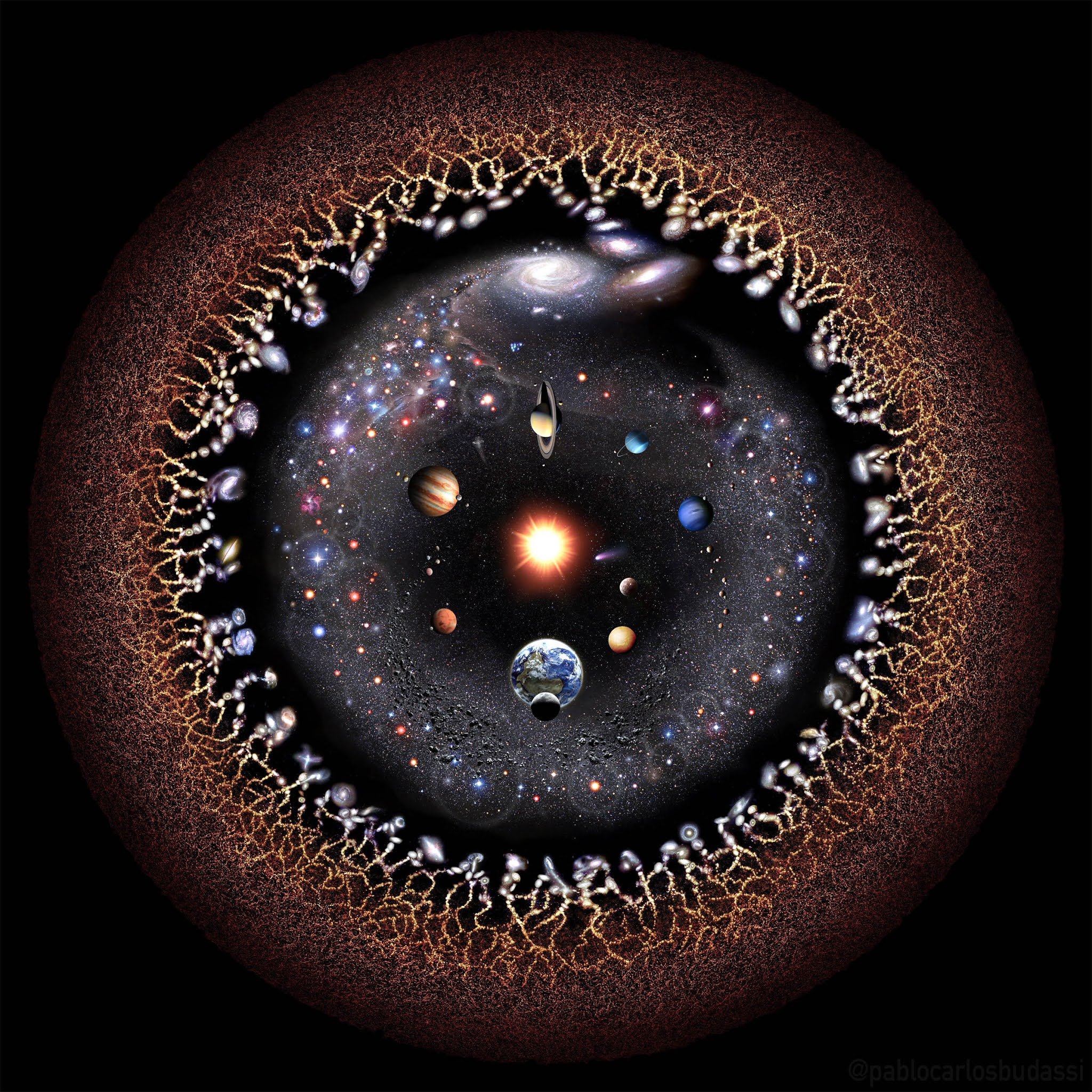
To expand on this idea: imagine the bulbous center of the Mandelbrot set, the solid, stable region, analogous to our lived experience here on Earth. It’s where the values are bound, where things make sense, where time and space feel consistent. But as you move outward, approaching the edge of that central bulb, you enter the infinitely complex boundary. I see this as similar to what we perceive when we look out into the cosmos.
No matter how far we peer into space, we never reach a true “edge.” There’s always more, more galaxies, more questions, more mystery.
We exist in a world that feels almost four-dimensional, but not quite, just as the Mandelbrot set approaches two dimensions without ever fully becoming a true two-dimensional shape. It’s always unfolding toward that next level of complexity, but never fully actualizing it.
Why? – Violations of Linear Space-Time
Within our bounded world, we still experience phenomena that hint at interaction with something beyond it. Things like:
These aren’t just strange occurrences, they’re violations of linear space-time. For instance, when a medium brings through a message from someone who has passed, or a remote viewer sees an alien civilization on Mars 3000 years ago, or top-secret NSA files in a filing cabinet, they are interacting with information that bypasses space and time entirely.
How is that possible unless consciousness, or at least information, has access to a higher-dimensional structure that we cannot fully perceive?
Just because we can’t see this dimension doesn’t mean it’s not there. After all, the simple formula behind the Mandelbrot set contains not just the solid region, but the boundary, the infinite detail, and infinity itself. It’s all encoded in one compact expression.
If we’re using the Mandelbrot set as a metaphor for reality, and we imagine ourselves existing within the bounded interior, it may seem paradoxical that we can access the infinitely complex boundary (or anything beyond it) without physically traversing that distance. But here’s the key: the boundary in a fractal like the Mandelbrot set isn’t spatially far away, it’s perceptually encoded. In fact, every point within the set is infinitely close to the boundary if you zoom deeply enough. Psychedelics and other plant medicines may function like a cognitive zoom lens, temporarily altering the brain’s filtering mechanisms and revealing patterns and dimensions that are normally hidden from ordinary perception.
The brain itself is a fractal system, with recursive structures in its neural architecture and activity patterns. Under psychedelics, the brain’s default mode network which usually keeps our experience grounded and predictable becomes disrupted. This allows for a flood of sensory, emotional, and symbolic information to surface. In that altered state, one may begin to perceive non-linear patterns, seemingly impossible geometries, or even entities that exist outside of time, phenomena that mirror what we find when zooming in on the Mandelbrot set’s fractal edge. From this perspective, we’re not being transported somewhere else; instead, psychedelics reveal that the deeper structure of reality and consciousness itself already exists at the fractal boundary between order and chaos.
So, while the boundary may seem “far” in abstract terms, it is actually embedded all around us — hidden behind the cognitive and perceptual structures we take for granted. Psychedelics don’t take us to another place; they remove the filters that keep us from seeing the deeper, more dimensional nature of where we already are.
Mandelbrot Region | Analogy | Experience |
Inside the Set | Physical Reality / Incarnation | Order, structure, “normal life” |
Boundary of the Set | Bardo / Duat / Liminal Consciousness | Chaos, psychic phenomena, the veil |
Outside the Set | Infinity / Source / Spirit | Formless, transcendent, ungraspable |
⊙ The Inside of the Mandelbrot Set
(Points that stay bounded under iteration)
→ Represents “Reality” as we know it
◉ The Boundary of the Set
(Infinite detail, never repeats, chaotic yet not divergent)
→ Represents the Bardo, the Duat, the Dreamtime
⊗ The Outside of the Set
(Points that escape to infinity)
→ Represents the Absolute or the Infinite
Uno Reverse Card 🔄
But what if we’re not sitting in the stable, bounded center of the Mandelbrot set at all?
What if our existence takes place along its infinitely complex boundary, the edge where order and chaos collide?
In the Mandelbrot set, the interior points are calm, their behavior is predictable, they stay bounded. The points outside the set clearly diverge into infinity. But the boundary? That’s where things get weird. Every zoom reveals new, intricate patterns. It’s a place of perpetual novelty, where you can never truly find repetition, yet structure is still somehow present.
That’s what consciousness feels like. That’s what life feels like.
We’re not existing in pure order or pure chaos — we’re navigating the razor-thin edge between the two.
The human experience — dreams, paradoxes, quantum uncertainty, psychic impressions, synchronicities — feels like it’s coming from this fractal frontier.
From this perspective, we are the fractal boundary, the living, perceptual interface between the known and the infinite.
And just like the Mandelbrot set’s edge, no matter how far we zoom in on our world, whether through a microscope, telescope, or meditative mind, we never reach a final answer. Only deeper, more intricate questions.
Why this also works:
Implication:
Consciousness emerges from the stillness of spirit (inside), lives on the fractal edge (boundary), and risks losing itself in chaos or awakening (outside).
Why Both Can Be True:
This duality is exactly what fractals and mysticism are all about. It mirrors the Hermetic axiom:
“As above, so below; as within, so without.”
It depends on which axis you view from — are we fractaling into form, or out of it?