Plato (& Christianity)
Plato, a classical Greek philosopher who lived approximately four centuries before the birth of Christ, developed a set of philosophical ideas that, while not Christian, had elements that resonated with and influenced Christian theology in various ways.
Theory of Forms: Plato’s Theory of Forms posited that the material world is not the true reality but merely a shadow of the true reality, which is a realm of ideal forms. Early Christian thinkers found a parallel in this concept with Christian teachings about the spiritual realm being the ultimate reality, as compared to the temporal, physical world. The Platonic idea of the soul’s ascent to a higher understanding of these forms was likened to the Christian pursuit of spiritual enlightenment and closeness to God.
The Nature of the Soul: Plato believed in the immortality of the soul, an idea that aligns with Christian beliefs about eternal life. His view that the soul pre-exists before birth and that its ultimate goal is to return to a state of perfection was adapted in various ways by Christian theologians, who emphasized the soul’s journey towards unity with God.
The Allegory of the Cave: Plato’s Allegory of the Cave, where prisoners perceive reality only as shadows on a wall and one escapes to see the real world, was used by Christian writers as a metaphor for spiritual awakening. The journey from the darkness of the cave into the light symbolizes the journey from ignorance to the enlightenment of Christian faith.
Plato’s Influence on Early Church Fathers: Several early Christian theologians, such as Augustine of Hippo and Origen, were deeply influenced by Platonic philosophy. Augustine, before converting to Christianity, was a follower of Neoplatonism, a later development of Plato’s ideas. He later integrated many Platonic concepts into Christian doctrine, especially the idea of the spiritual world being more real and true than the physical world.
Concept of the Good: Plato’s idea of the Good, the ultimate principle that transcends all forms and is the source of all reality and knowledge, was similar to the Christian understanding of God. This parallel helped early Christians to articulate their understanding of God as the ultimate source of all goodness and truth.
Ethical Teachings: Platonic ethics, which emphasize virtue and the well-being of the soul, were compatible with Christian moral teachings. The idea that living a morally upright life leads to true happiness and fulfillment resonated with Christian emphasis on virtues and living in accordance with divine will.
While Christianity and Platonism are distinct systems of thought with different origins and conclusions, the influence of Platonic philosophy on early Christian theology is undeniable. It provided a framework for early Christians to articulate and develop their understanding of the spiritual world, the nature of the soul, and the pursuit of truth and goodness.
However, not all aspects of Plato’s philosophy were incorporated into Christian theology. As Christian doctrine developed, it diverged in significant ways from Platonic thought.
The Platonic Solids
The shapes we call Platonic solids (tetrahedron, cube, octahedron, dodecahedron, icosahedron) were known before Plato. Plato did not discover them, but he made them famous. Plato’s contribution was philosophical, not mathematical. That’s why they’re called “Platonic” solids.
Platonic solids are perfectly symmetrical three-dimensional shapes whose faces are identical regular polygons and whose angles and edges are all equal.
If you were to play a board game and needed fair-sided die, the platonic solids would be the only five shapes possible.
They have been studied for thousands of years both for their mathematical beauty and for their philosophical symbolism.
Tetrahedron
4 Equilateral Triangle Faces
4 x 180° = 720°
Element: Fire
Cube
6 Square Faces
6 x 360° = 2160°
Element: Earth
Octahedron
8 Equilateral Triangle Faces
8 x 180° = 1440°
Element: Air
Icosahedron
20 Equilateral Triangle Faces
20 x 180° = 3600°
Element: Water
Dodecahedron
12 Regular Pentagon Faces
12 x 540° = 6480°
Element: Cosmos
Dimensions
Humans use mathematics to define and explore spatial dimensions.
A point is considered zero-dimensional, as it has no length, width, or depth, it simply exists as a location. A line is one-dimensional, characterized by length alone. In the second dimension, we introduce a new axis, width, forming a flat plane where closed shapes like polygons and circles can exist.
Moving into the third dimension, we add depth, represented by the z-axis, allowing us to describe volumetric forms like cubes, spheres, and all physical objects as we perceive them in space.
However, when it comes to dimensions beyond the third, we run into a cognitive limit. Visualizing a fourth spatial axis, one that is perpendicular to all three we already know, is beyond the capabilities of our spatial perception. We can infer the existence of higher dimensions mathematically or symbolically, but we cannot fully visualize them in the same way we understand length, width, and depth.
In physics, the concept of a fourth dimension takes a different form. Rather than introducing another spatial direction, the fourth dimension is understood as time. By combining the three spatial dimensions with time, we form what is known as spacetime, where every event is defined not only by where it occurs, but also when. Unlike spatial dimensions, which we can move through freely, time appears to flow in a single direction, making it fundamentally different in how it is experienced.
Mathematically, however, a fourth spatial dimension can still be defined. Just as a cube extends a square into three dimensions, a four-dimensional shape, such as a tesseract, extends a cube into a higher spatial dimension. While we cannot directly perceive such objects, we can represent them through projections and analogies, offering glimpses into how higher-dimensional space might behave. In this way, the fourth dimension sits at the boundary between what we can experience and what we can only describe, mathematically precise, yet intuitively out of reach.
~ Can we have a fraction of a dimension? ~
Yes. Non-integer dimensions are described by fractals.
Fractals
The world of fractals is rich and varied, and different types are classified based on how they’re generated, what properties they exhibit, and where they appear (in math vs. nature).
For a shape to be considered a fractal, it must:
- Have detail at every scale (or self-similarity across multiple scales)
- Be too “complex” for its topological dimension
- Have a non-integer (fractional) dimension
Some examples of fractals and their key features:
Type of Fractal | Key Feature | Example |
Self-Similar | Identical repetition at all scales | |
Stretched/scaled versions at each level | Geological formations | |
Random (Stochastic) | Includes randomness | Clouds, terrain, lightning |
Escape-Time | Based on how fast values “escape” | |
Iterated Function System | Built from geometric rules/transformations | |
Strange Attractors | Chaotic systems in motion | |
Space-Filling Curves | Fills space without overlap |
The Mandelbrot Set
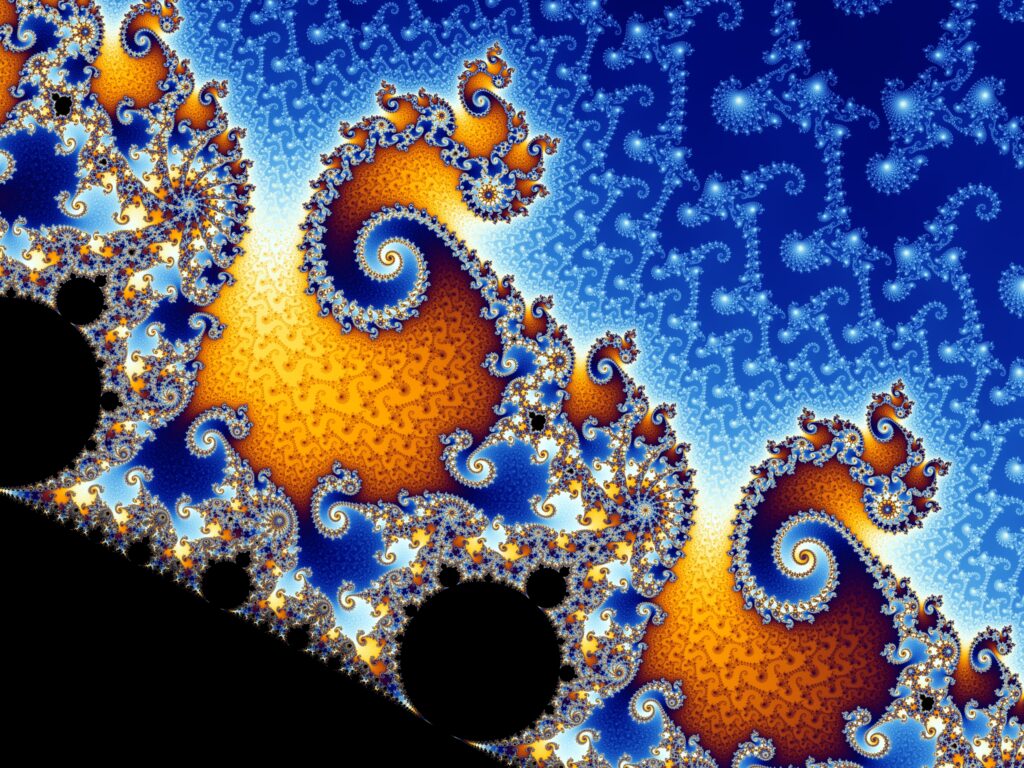
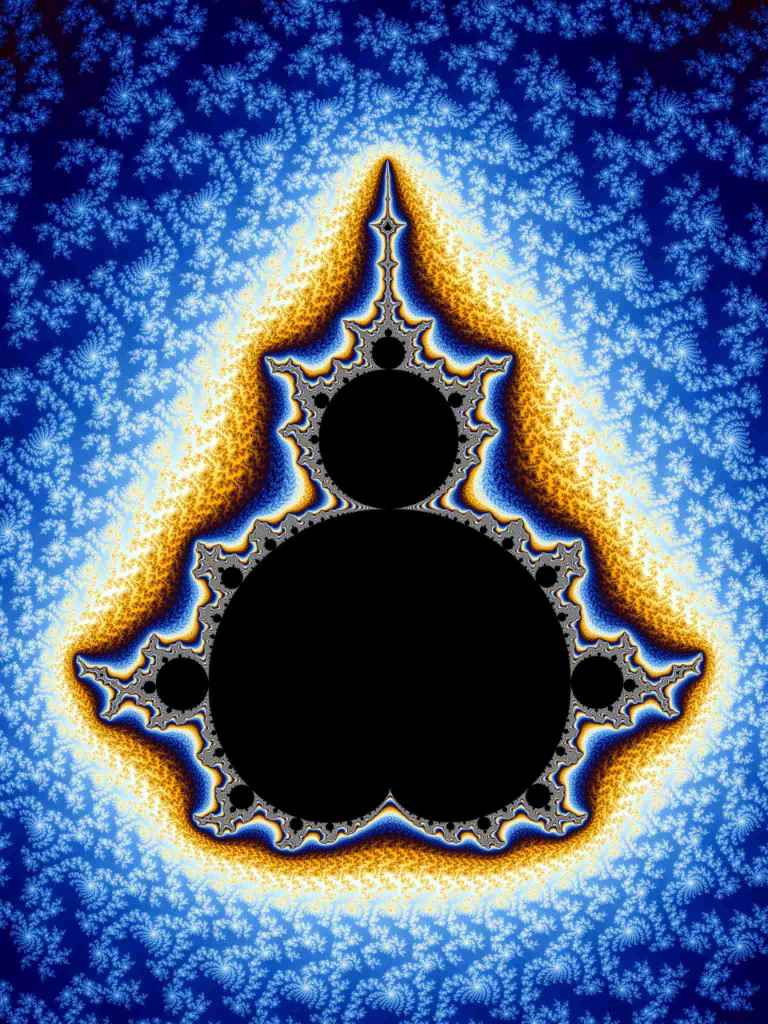
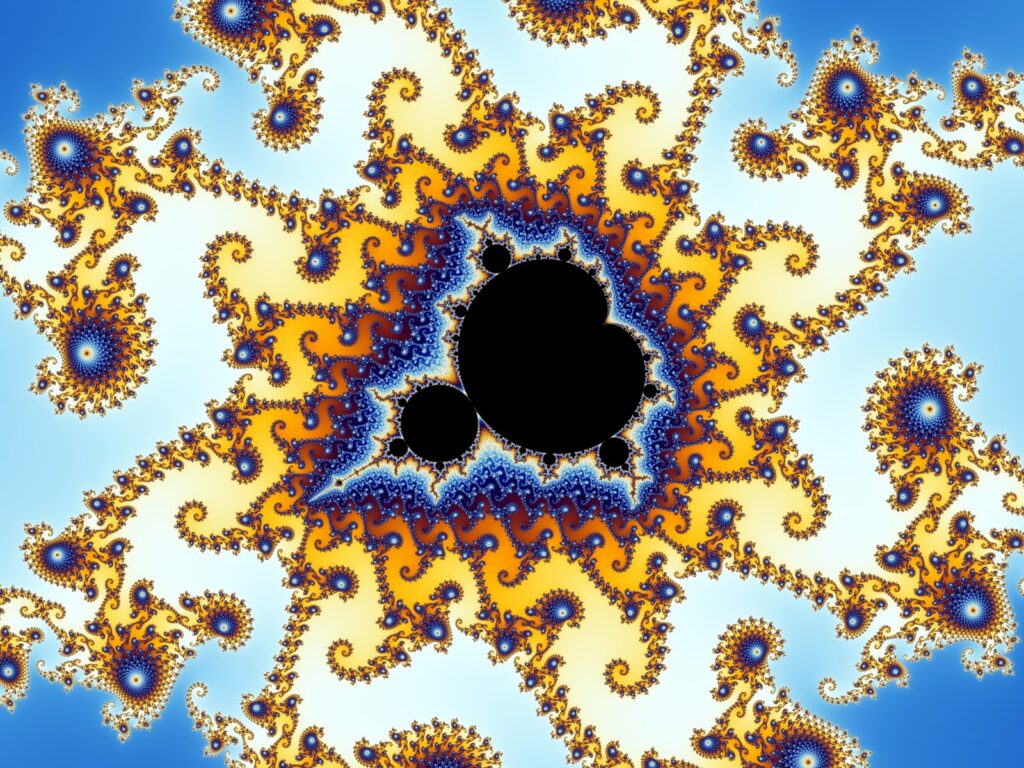
The Mandelbrot set, defined by the equation zn+1 = zn2 + c, is plotted on a two-dimensional complex plane. The set itself is two-dimensional, as it occupies a finite area. However, its boundary exhibits fractal behavior and has a Hausdorff dimension of 2.
At first glance, this seems counterintuitive. A circle, for example, is a simple shape on a plane with a smooth, well-defined boundary. Its edge is one-dimensional, even though it encloses a two-dimensional region.
The Mandelbrot set behaves very differently. Its boundary is infinitely complex: no matter how far you zoom in, new layers of structure continue to appear. Unlike the smooth edge of a circle, the boundary never becomes simple or regular at any scale.
Key Takeaway: The Mandelbrot set is 2D, but its boundary is so infinitely complex that it also has a dimension of 2.
Exorcism
How To Release Yourself from a Deal with The Devil
There are two specific prayers or invocations intended to protect against entities and other negative influences. The first is a “Clearing Prayer” or “Prayer of Exorcism,” which is used to remove negative energies, entities, or influences from a person, place, or object. It calls upon divine forces, like the Archangel Michael and the Band of Mercy, for assistance.
The second is the “Robotic Prayer,” which is specifically aimed at countering aetheric robot-like entities created by the “Dark Brothers.” These entities can be commanded to disappear in the name of Jesus Christ, and this action will lead to their disintegration.
Find the prayer online >here< or PDF version >here<.
What Does Kodoish and Adonai Tsebayoth Mean?
“Kodoish, Kodoish, Kodoish, Adonai Tsebayoth” is a phrase often found in certain mystical or esoteric Christian traditions, and it has roots in ancient Hebrew and Aramaic languages. Each part of this phrase carries a specific meaning:
- Kodoish (or Qadosh): This word is Hebrew in origin and means “holy” or “sacred.” In a religious or spiritual context, it is often used to express the holiness or sanctity of God. The repetition of the word “Kodoish” three times is a form of emphasis, a common practice in Hebrew to denote the utmost degree of something. In this case, it emphasizes the supreme holiness of God.
- Adonai: Also a Hebrew term, “Adonai” is one of the names used to refer to God in the Hebrew Bible. It is traditionally used in prayer and scripture reading as a respectful substitute for the name of God, which is considered too sacred to be spoken aloud.
- Tsebayoth (or Tzva’ot): This is another Hebrew word, and it means “hosts” or “armies.” In a biblical context, “Tsebayoth” often refers to the “hosts of heaven” or “heavenly hosts,” which can imply angels or celestial beings that serve God.
So, “Kodoish, Kodoish, Kodoish, Adonai Tsebayoth” can be translated as “Holy, Holy, Holy, Lord of Hosts.” This phrase is similar to the “Trisagion” in Christian liturgy, which is a prayer or hymn that repeats the word “holy” three times in reference to God. The inclusion of “Adonai Tsebayoth” emphasizes God’s dominion over the heavenly hosts or angels.